Joint Pain Relief in Knoxville: When the Problem Isn't Where It Hurts

Joint pain can be frustrating, especially when you keep treating the sore spot and the pain still comes back. A lot of patients assume the place that hurts must be the place causing the problem. That seems logical. If your knee hurts, you focus on the knee. If the pain sits around your shoulder blade or runs down your arm, you start stretching, rubbing, or massaging that exact area.
But one thing we commonly see in our office is that the painful area is not always the real driver.
When you search for “joint pain relief chiropractor knoxville,” you’re usually not looking for a vague explanation. You want to know why the same pain keeps hanging around and why the treatments aimed at the sore spot never seem to fully solve it.
At Dr. Arthur Poisal Chiropractic, we try to make sense of those patterns before jumping into care. We take time to listen, examine the area that hurts, and also test the joints, muscles, and nerves that may be feeding into it. If you want a helpful overview of our approach, you can learn more about joint pain relief in Knoxville.
Joint pain relief chiropractor knoxville patients often need a bigger-picture answer
A lot of people come in frustrated because they have already spent weeks or months trying to calm down the painful spot. They may have iced the knee, stretched the groin, massaged the shoulder blade, changed workouts, bought braces, or taken a break from activity. Sometimes that helps for a few days. Then the pain returns.
That is usually the moment when referred pain needs to be considered.
Referred pain means the area that hurts is real, but the main source of irritation may be somewhere else. This is not rare. It is part of how the body is wired. Joints, discs, muscles, and nerves share pathways, and the brain does not always label the exact structure perfectly.
Two patterns come up over and over again:
- Hip joint problems showing up as knee pain or groin pain
- Neck problems showing up between the shoulder blades or down the arm
Those patterns matter because they change what should be examined and what should be treated. If the driver is missed, people often end up chasing symptoms instead of making progress.
How hip problems masquerade as knee and groin pain
Hip problems can be surprisingly misleading.
The hip joint sits deep in the front of the body, close to the groin. It is a ball-and-socket joint with a strong capsule around it, and it is surrounded by muscles that help control rotation, balance, and force transfer when you walk, squat, climb stairs, or get in and out of a car.
When that joint becomes stiff, irritated, or arthritic, pain does not always stay neatly in one place. The most common pattern is deep groin pain, but it can also travel partway down the front of the thigh and sometimes show up at the knee. A lot of patients are surprised by that, but it makes anatomical sense. The nerves that supply the hip also carry sensation from nearby regions, so the brain may register the problem as groin discomfort, thigh aching, or knee pain.
One thing we commonly see in our office is someone who has been told they have a “bad knee,” even though the knee never had a clear injury and imaging or treatment never fully explained the symptoms. The knee may feel sore with walking, stairs, or standing from a chair, but the real driver turns out to be a hip that has lost motion.
There are a few clues that often point us in that direction.
Patients with a hip-driven pattern often notice:
- Trouble putting socks or shoes on
- Difficulty crossing one leg over the other
- A pinch, catch, or grinding feeling deep in the groin
- Stiffness getting up after sitting
- Knee pain that does not match a clear knee-related cause
- Pain that seems to spread rather than stay isolated right on the knee
In those cases, the knee itself may look fairly normal. It may not be swollen. It may not feel unstable. Pressing on the knee may not reproduce much. But rotating the hip or loading the hip joint often brings the familiar pain on quickly.
That is why treating only the knee can disappoint people. If the hip is not moving well, the knee ends up absorbing stress differently with every step. Until that pattern is recognized, symptom relief tends to be temporary.
How neck problems show up between the shoulder blades or down the arm
The neck creates a similar kind of confusion.
The lower part of the neck, called the cervical spine, is where nerves exit and travel through the shoulder region and down the arm. The muscles around the shoulder blades also depend on nerve supply that traces back to the neck. Because of that, irritation in the cervical joints, discs, or nearby nerve roots can create pain far away from the center of the problem.
A lot of patients assume shoulder-blade pain must come from a knot that needs to be rubbed out. Sometimes that is true. But sometimes the reason that spot never stays better is that the irritation is being driven by the neck.
The classic pattern is pain between the shoulder blades, near the inside edge of the shoulder blade, or across the top of the shoulder that keeps returning no matter how much massage, stretching, or foam rolling you try. The area may feel tight, burning, aching, or hard to “release.” Some people also notice that symptoms shift when they turn their head, look down, or sleep in certain positions.
That change with neck position is an important clue.
When the nerve itself becomes more involved, the pattern may move farther down the arm. You might notice tingling, numbness, zapping, or a strange heavy feeling into the shoulder, arm, forearm, or hand. That does not automatically mean something severe is happening, but it does tell us the exam needs to include the nerve and the neck, not just the sore muscle.
One thing we commonly see in our office is a person who keeps getting short-term relief from shoulder-blade work, only to have the symptoms flare again because the lower neck keeps reproducing the problem. In that situation, rubbing the blade is not necessarily wrong. It just is not enough.
How an examiner tells the two apart
A good exam is really about answering a simple question: what movement or structure actually reproduces your familiar pain?
For hip-related knee or groin pain, one of the first things we look at is hip range of motion. A hip problem often limits rotation, especially internal rotation, which is the motion of rolling the leg inward. That movement may feel stiff, pinchy, or painful deep in the groin. We also compare sides, watch how you walk, and see whether loading the hip recreates the knee pain.
For neck-related shoulder-blade or arm pain, we pay close attention to whether symptoms change when you turn, tilt, extend, or bend the neck. If moving the neck reproduces the shoulder-blade pain or sends symptoms farther down the arm, that is useful information. It tells us the painful area may be getting input from the cervical spine.
We also use strength and nerve screening to sort out how involved the nerve may be. In plain language, that means checking reflexes, testing sensation in the skin, and comparing muscle strength. In the leg, we want to know whether the hip problem is simply referring pain or whether something else is irritating the nerves. In the arm, we want to know whether the neck is just creating referred pain or whether the nerve is becoming more directly irritated.
Simple movement tests help too. We try to load one area at a time. If rotating the hip reproduces the knee pain, that tells us something. If moving the neck changes the shoulder-blade or arm symptoms, that tells us something else. The exam is not about doing random tests. It is about narrowing down the source in a way that makes the care plan more accurate.
Why treating only the sore spot disappoints people
This is where many people lose time.
If the real issue is a stiff, irritated hip joint, months of knee massage, knee sleeves, and quad stretching may only nibble around the edges of the problem. If the real issue is coming from the neck, repeated work on the shoulder blade may calm things down for a day or two without changing the reason it keeps coming back.
That does not mean previous care was careless. It usually means the driver was not fully identified.
A thorough assessment before treatment is what helps prevent that. We want to know whether your pain is local pain, referred pain, nerve-related pain, or a mix of those. That is the difference between chasing symptoms and building a plan that actually fits what your body is doing.
What care usually involves
Once the pattern is clearer, care tends to be more practical and more targeted.
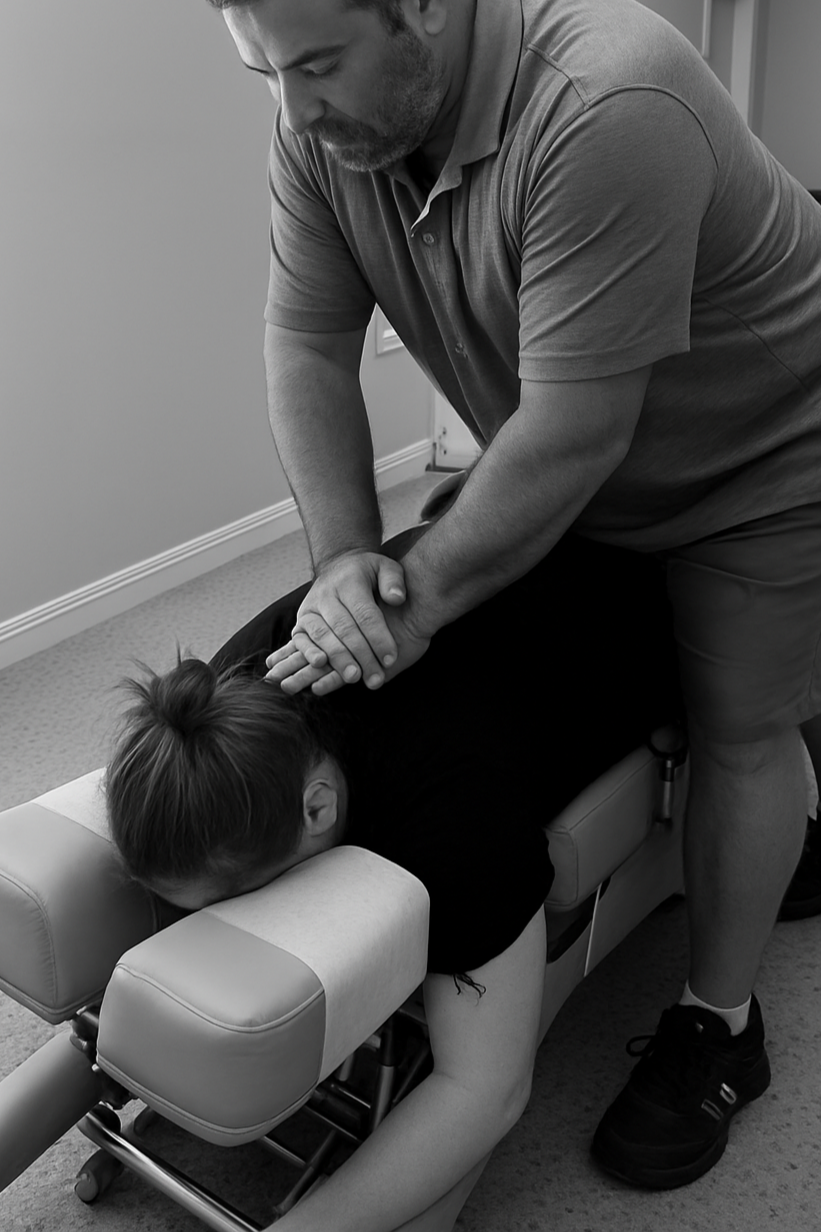
Hands-on care may be used to restore movement where it is restricted, whether that is the hip, the neck, or nearby joints that are part of the same movement pattern. The goal is not to force a perfect posture or promise a quick fix. The goal is to improve motion, reduce irritation, and help the body move with less compensation.
Exercise is usually part of the plan too, but it should match the problem. If the hip is the driver, we may focus on hip mobility, strength, and control so the knee is not constantly asked to absorb extra stress. If the neck is involved, we may work on neck motion, shoulder control, and the habits that keep overloading the area.
Activity guidance matters as well. Sometimes small changes in sitting position, lifting, training volume, sleep setup, or the way you return to exercise make a meaningful difference. Many people do not need to stop moving completely. They usually need a better strategy for loading the irritated area.
In selected cases, shockwave therapy may also be considered for persistent tendon or soft-tissue problems after assessment. It is non-invasive, and for the right diagnosis it can be a useful tool. It can also be uncomfortable during treatment, it does not work for every diagnosis, and it is not appropriate for tears, nerve symptoms, or joint instability. That is why we do not treat it like a blanket solution.
No two cases are exactly alike. Some people need more mobility work. Some need more strengthening and control. Some need to be referred for additional evaluation. The important part is understanding what is actually driving the pain before deciding what to do next.
Joint pain relief chiropractor knoxville patients can feel comfortable visiting
Choosing care for joint pain should not feel rushed or confusing. You deserve a provider who listens carefully, explains what the exam is showing, and helps you make sense of whether the pain is truly coming from the sore spot or being referred from somewhere else.
At Dr. Arthur Poisal Chiropractic, we care for patients of all ages and activity levels. Some people want to get back to lifting, walking, or working without that nagging knee pain. Others want to understand why pain around the shoulder blade or down the arm keeps returning. Our job is to assess the pattern, explain it clearly, and recommend care that makes sense for your goals.
WHAT PATIENTS HAVE SAID…
“Year after year i keep going back to see Dr Art. He understands my concerns as i age, and can work on any issues that arise to help me feel my best and perform at an active level. Thank you!”
- Cynthia Jefferies
If you’ve been searching for a joint pain relief chiropractor knoxville patients can trust, you don’t have to sort this out on your own. Call (865) 687-5700, or complete the contact form and we’ll be happy to call you back. Let’s talk about what you’re experiencing and whether personalized care may be a good fit.