Knee Arthritis Pain Relief: How a Chiropractor Can Help

If knee arthritis has made stairs, walks, or getting out of a chair more difficult, you may feel like your choices are limited. Perhaps you’ve been told to wait until the joint gets bad enough for a replacement.
That can be discouraging. But an arthritic knee isn’t automatically a lost cause.
A knee arthritis pain relief chiropractor can’t reverse cartilage loss or promise to rebuild the joint. What we can do is look at the whole picture, reduce stress on irritated tissues, improve movement where appropriate, and help you build the strength needed to stay active.
At Dr. Arthur Poisal Chiropractic, we take time to listen before creating a customized plan. Your care should fit your age, health, goals, and daily routine, not just an image from an X-ray.
Arthritis on an X-ray doesn’t tell the whole story
Knee arthritis usually involves changes to the cartilage and other tissues inside the joint. Over time, the joint may become stiffer, and activities that once felt easy may become uncomfortable.
Still, the amount of wear shown on an X-ray doesn’t always match the amount of pain you feel. Pain is influenced by more than cartilage, including muscle weakness, joint stiffness, tendon irritation, swelling, sleep, stress, activity levels, and how you move.
An X-ray can be useful, but it is only one part of the assessment. We also want to understand:
- What movements are difficult for you?
- How far can you comfortably walk?
- Does the knee hurt more on stairs or uneven ground?
- Are your hips, ankles, or lower back affecting how you move?
- What activities do you want to return to?
Your answers help guide a plan that focuses on function, not just a picture.
How a knee arthritis pain relief chiropractor may help
The goal of care is not to pretend arthritis isn’t there. The goal is to help you work with the joint you have and make movement more comfortable.
Depending on your assessment, care may include:
Gentle hands-on care
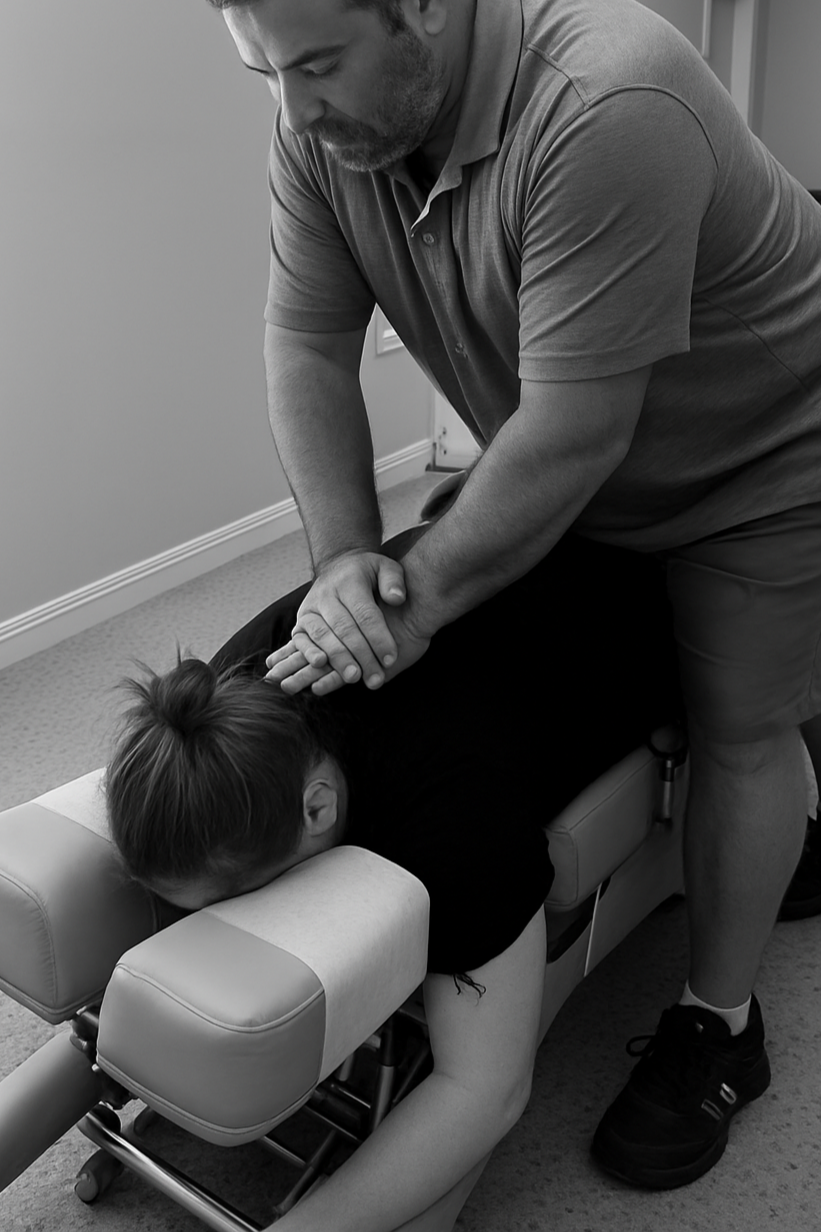
Gentle adjustments or mobilization may be used to improve movement in joints that are stiff or not sharing load well. This may include the knee, hip, ankle, pelvis, or spine, depending on what we find.
We don’t use the same technique for every person. An active adult, someone recovering from an injury, and an older adult with arthritis may all need different levels of pressure and support.

Rehabilitative exercises
Strength is one of the best ways to support an arthritic knee over the long term. Stronger thigh, hip, and core muscles can help you control movement and reduce unnecessary strain during walking, standing, and stairs.
Your program may include modified movements such as:
- Supported sit-to-stands
- Gentle step-ups
- Quadriceps strengthening
- Hip stability exercises
- Calf and hamstring mobility work
- Balance exercises
- Controlled range-of-motion movements
The right exercise should feel challenging enough to build capacity without causing a major flare-up. We can adjust the position, resistance, repetitions, and pace to meet you where you are.
Support for related back and leg concerns
Sometimes the knee is not working alone. A stiff hip, limited ankle movement, or irritated lower back may change the way you walk and place more stress on one side.
When appropriate, your customized plan may include decompression therapy or other care for related back and leg concerns. Decompression therapy is not intended to regrow knee cartilage. It may be considered when the spine or surrounding areas are contributing to difficulty with movement.
Why motion and strength matter
It’s understandable to protect a painful knee by moving less. Rest can feel safer in the short term. But too much time on the couch can lead to weaker muscles, more stiffness, and less confidence.
Regular, manageable movement helps maintain joint mobility and muscle support. It also helps you keep doing the everyday activities that matter to you.
You don’t have to begin with long walks or intense workouts. Start with a level that feels realistic. A few minutes of movement several times a day may be more helpful than doing too much once and needing several days to recover.
Walking, cycling, water exercise, and other low-impact activities can be useful options. The best choice is the one you can do consistently and tolerate well.
Why the pain keeps coming back
One thing we commonly see in our office is that long-standing knee pain is not just about the joint itself. After months of irritation, your nervous system can become more protective. Movements that used to feel normal can start to feel threatening, even when you are not causing new harm each time. That response is real. It is not “all in your head.”
A lot of patients also develop guarding around the knee without realizing it. The muscles around the hip, thigh, and lower leg tighten up to protect the area, which over time can make movement feel stiff and tiring.
You may notice practical signs of this, such as:
- Keeping the knee straighter than usual
- Taking shorter steps
- Turning the foot out
- Using your arms more to stand up
- Avoiding stairs when possible
Avoiding painful movement can also reduce strength and capacity over time, so everyday tasks start to feel harder.
Another pattern we often talk through with patients is the boom-bust cycle. You have a good day, so you do a lot. Then the knee flares up, so you rest completely, and the cycle repeats. Flare-ups in that situation are usually better treated as information about your current capacity, not automatic proof of new damage.
Pacing activity between those extremes helps break the cycle. A plan that starts at the right level and progresses gradually is usually how this gets interrupted, and we take time to find that starting point.
Everyday habits that can support your knees
Care in the clinic is only one part of managing an arthritic joint. Small daily choices can also make a meaningful difference.
Consider weight management without shame
If weight loss is appropriate for you, even a modest reduction may decrease the load on your knees. If you have medical conditions or take medications, speak with your primary care provider before making major changes to your diet or activity.
Keep walking at a manageable pace
Walking can help maintain strength and confidence. Start with a comfortable distance, use supportive shoes, and build gradually as your tolerance improves.
Try cycling
A stationary bike or gentle outdoor cycling can provide movement with less impact than some activities. Adjust the seat so your knee is not forced into an uncomfortable position, and begin with light resistance.
Stay off the couch, but respect your limits
You don’t have to push through sharp pain, but you also want to avoid becoming completely inactive. Change positions during the day, move your joints gently, and build progress through steady, repeatable actions.
How we adapt care for older joints
Older adults deserve care that is careful, respectful, and focused on independence. We understand that your goals may be practical:
- Walking through the grocery store
- Getting up from a favorite chair
- Playing with grandchildren
- Gardening
- Traveling
- Sleeping more comfortably
- Moving around your home with confidence
We consider your medical history, balance, bone health, medications, previous injuries, and current activity level. Treatment may be gentler and more closely monitored when needed.
You should never feel rushed or pressured to do more than your body is ready for.
Where shockwave therapy may fit
Arthritic knee discomfort does not always come only from the joint itself. Tendons and other soft tissues around the knee can also become irritated, especially when movement patterns change.
Shockwave therapy uses sound-wave energy applied to targeted soft tissue. It may help some people with stubborn tendon or surrounding tissue pain. It is not a way to replace cartilage or eliminate arthritis, and it should not be presented as a stand-alone cure.
At our clinic, shockwave therapy may be considered as part of a broader plan that includes movement, strengthening, and activity guidance. You can learn more about the approach on our Shockwave Therapy service page.

What chiropractic care can, and can’t, do
It’s important to have realistic expectations.
Chiropractic care cannot:
- Reverse established cartilage loss
- Guarantee that you will avoid surgery
- Replace medical evaluation when surgery or another treatment is needed
- Promise that every person will respond the same way
It may help you:
- Move a stiff joint or related area more comfortably
- Calm irritated muscles, tendons, and soft tissues
- Improve strength and control
- Build confidence with walking and daily activities
- Stay active while managing symptoms
- Understand what increases or reduces your discomfort
The Arthritis Foundation’s information on chiropractic care also emphasizes the importance of individualized care and realistic expectations. If your knee is hot, acutely swollen, unstable, or severely painful, seek medical evaluation before beginning treatment. We can also help determine when another healthcare professional should be involved.
When surgery is genuinely the right conversation
It’s understandable to want to avoid surgery, but some knee problems truly deserve an orthopedic conversation.
That may include:
- A fracture involving the knee joint
- A complete ligament tear causing major instability
- Certain meniscus or cartilage injuries
- Advanced joint damage
- Severe deformity
- Repeated locking or giving way
- Pain that continues to limit your life despite a consistent, well-planned conservative program
Prompt medical attention is also important if a knee suddenly becomes very swollen, red, hot, or hard to move, especially with fever, or after an acute injury with visible deformity or an inability to bear weight.
Choosing a conservative path is not about delaying necessary care. It is about making sure the decision is based on symptoms, examination, imaging, and goals.
Questions like these can help guide that conversation:
- “What would happen if I tried structured conservative care first?”
- “What changes would show the plan is working?”
If your exam suggests a referral makes sense, we’ll say so clearly and help coordinate the next step.
A personalized plan can help you keep moving
You don’t have to wait until your knee becomes unbearable before asking for help. A thorough assessment can show which parts of your movement need attention and which activities may be safest to continue.
At Dr. Arthur Poisal Chiropractic, we serve patients throughout Knoxville, including the Whittle Springs and North Knoxville area. We’ll listen to what you’re experiencing, explain your options, and create a plan around your goals. You can also learn more about how we approach knee pain treatment in Knoxville.
If you’d like to talk about your knee and learn whether care may be appropriate, call us at (865) 687-5700. You can also fill out our contact form, and we’ll be happy to call you back.