Decompression Therapy for Back Pain: Who It Helps and Why

If your back has flared up and you’ve found yourself comparing inversion tables, over-the-door traction kits, and clinic treatment options late at night, you’re not alone. Decompression therapy for back pain often comes up during that search, especially when you want something that feels practical, affordable, and worth trying before committing to in-office care.
Written and clinically reviewed by Dr. Arthur Poisal, DC.
At Knox Chiro, we see this pattern all the time in Knoxville. Your back starts limiting sleep, workouts, work, or just getting through the day comfortably. You start researching. A home traction device looks simple enough. The bigger question is whether home traction is actually doing the same thing as in-clinic care, and whether it’s a safe fit for your situation.
Why People Reach for Home Traction First
One thing we commonly see in our office is that a back flare starts with one bad lift, a long drive, a weekend project, or a stretch of too much sitting. At first, a lot of patients assume it will calm down on its own.
Then a few days pass.
Now you’re searching for answers, reading forums, watching product demos, and trying to decide whether an inversion table or traction kit could help you fix it yourself. That makes sense. Home devices are easy to find, they usually cost less than a full course of care, and they give you the feeling that you can start doing something right away.
That hope matters. But it can also blur an important distinction: using a device at home is not the same as being assessed first and then having traction or spinal decompression therapy selected for a specific problem.
What Home Traction Actually Is
When people say “traction at home,” they usually mean one of a few things.
Inversion tables
An inversion table uses gravity and your body weight. You control the tilt angle yourself, and your spine is unloaded based on how far you invert and how your body responds in that position.
For some people, that can create a temporary feeling of stretch or pressure relief. For others, it can feel awkward, intense, or simply not helpful. The main point is that the force is not precisely customized to your exam findings. You’re deciding the angle, the duration, and when to stop.
Over-the-door and belt-style traction devices
These devices usually apply a lighter, more fixed pull. Some use your body position, some use straps, and some rely on a simple mechanical setup. They may create a stretching sensation, but they are still limited in how specifically they target a problem area.
They also don’t adjust themselves based on whether your symptoms are moving in a better direction or getting more irritated.
How that differs from in-clinic decompression
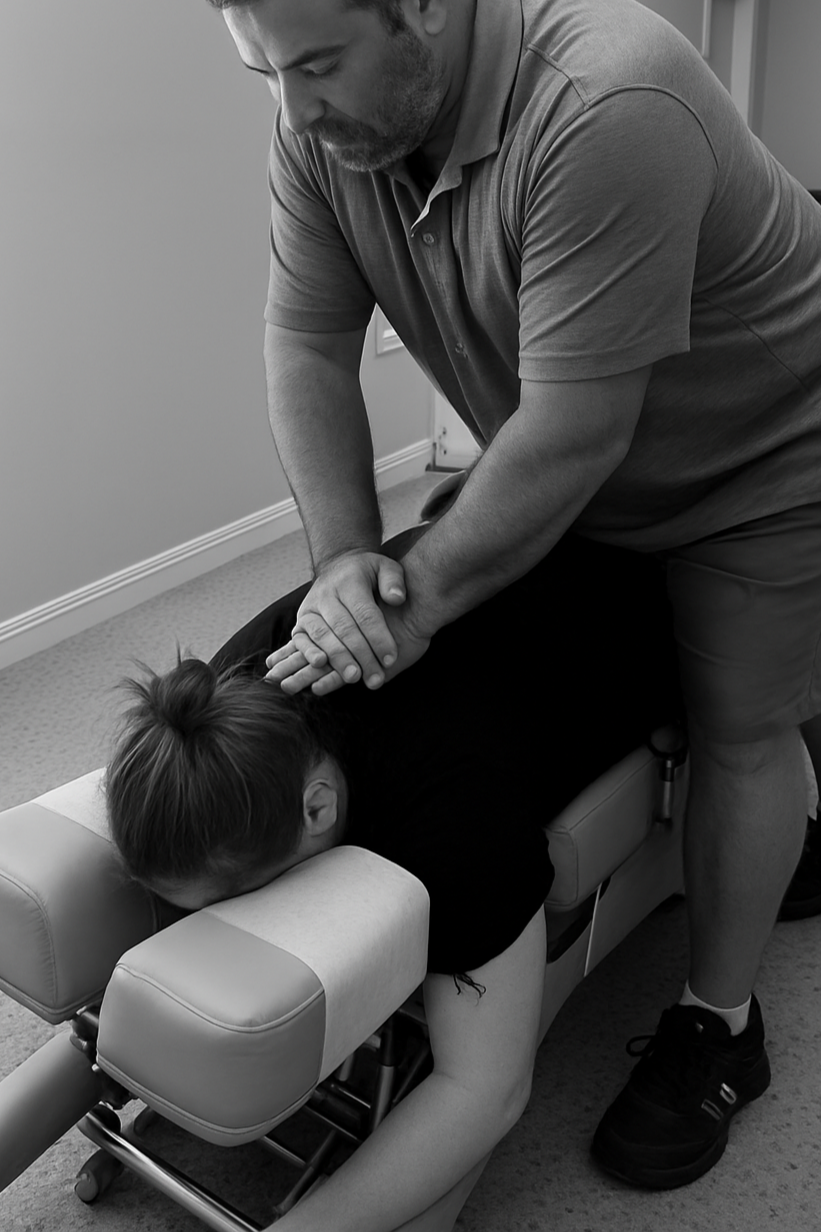
This is where the comparison matters. In clinic, you’re not just lying on a table and hoping for the best. A clinician has already examined you. Your history, movement, and nerve findings help guide whether traction-style care makes sense in the first place.
If spinal decompression therapy is considered, the positioning and force can be adjusted based on your assessment and your tolerance. Just as important, someone is watching how you respond. If your symptoms change in a way that looks unhelpful, the plan can be modified.
At home, you are your own clinician. You’re choosing the setup, the angle, the time, and the response plan, often without knowing whether your symptoms are coming from a problem that traction is likely to help.
Decompression Therapy for Back Pain: When Home Traction Might Be Reasonable
There are some situations where home traction may be a reasonable thing to discuss or carefully trial.
In general, the people who tend to tolerate it best are adults with mild, mechanical-feeling back stiffness who do not have nerve symptoms and who are simply looking for gentle relief. That might mean symptoms that feel local to the back, change somewhat with position, and are not traveling down the leg with numbness, tingling, or weakness.
This is a general description, not a diagnosis.
If your symptoms are mild, you have no major red flags, and the device is being used conservatively, some people do report short-term relief. But “reasonable to try” is not the same as “right for everyone,” and it definitely does not mean the device is addressing the actual source of the problem.
Who Should Not Try Home Traction?
Home traction is not something we’d suggest as a casual experiment if any of these apply:
- Disc herniation with progressive leg weakness or numbness
- Severe osteoporosis
- Recent spinal surgery or fusion
- Uncontrolled high blood pressure, glaucoma, or certain heart conditions, especially with inversion
- Pregnancy
- Vertigo or balance problems
There are also red flags that need prompt medical care rather than home trial and error:
- New loss of bladder or bowel control
- Saddle numbness
- Sudden significant weakness
- Symptoms after major trauma
If you’re dealing with any of those issues, the right next step is not more equipment. It’s getting evaluated.
How Can You Tell If It’s Helping?
This is where people often get stuck. A short-term stretch sensation is not the same thing as real improvement.
Signs that traction may be helping can include:
- Leg symptoms start moving more toward the spine instead of farther down the leg
- You can sit or walk a little longer before pain builds
- Sleep becomes easier
- Symptoms feel less sharp or less intense
That pattern suggests things may be calming down.
On the other hand, stop and get assessed if you notice:
- Pain spreading farther down the leg
- New or increasing numbness
- Weakness
- Symptoms that feel more aggressive after each session
- A lingering flare that keeps getting worse instead of settling
A lot of patients assume more pull means more benefit. That is not necessarily true. If a device is making your symptoms spread, intensify, or feel less stable, that matters.
Why an Assessment Matters Before You Buy Equipment
The most useful question usually is not, “Is traction good?”
The better question is, “Is this the right problem to apply traction to?”
That’s what an assessment is for.
Before we recommend a traction-style approach, we look at your history, how the pain behaves, what movements change it, whether nerve symptoms are involved, and how your strength and reflexes look when appropriate. We also screen for red flags and talk through whether imaging makes sense in your case.
That matters because not every sore back is a traction problem.
Sometimes the painful area is not the main issue. Tight or overloaded muscles, movement guarding, irritated joints, disc-related symptoms, or nerve sensitivity can each change what treatment makes sense. That’s part of the bigger-picture approach we use in our office. We want to understand why your symptoms are acting the way they are, not just throw a device at them.
For selected disc-related problems, in-clinic spinal decompression therapy may be considered after that assessment. In other cases, it may not be the best fit at all.
And if your exam suggests a persistent soft-tissue issue instead of a traction-type problem, shockwave therapy may sometimes be part of the conversation. It’s non-invasive, and some patients tolerate it well, but it can be uncomfortable. It’s also not for every diagnosis, and it’s not intended for tears, nerve symptoms, or instability. No treatment should be sold as a guarantee.
Let’s Figure Out What Fits
If you’re trying to decide between home traction, an inversion table, decompression therapy for back pain, or a completely different direction, you don’t have to guess your way through it alone.
Call Dr. Arthur Poisal Chiropractic at (865) 687-5700 or fill out the contact form. We’ll have a straightforward conversation about whether traction, decompression, or something else makes the most sense for your symptoms and your goals.