Posture Correction in Knoxville, TN: Fix the Cause, Not Just the Ache

You catch yourself slouched, pull yourself upright, and promise you are going to sit or stand better from now on. Then ten minutes later, you realize you have folded right back into the same position again.
A lot of patients bring this up quietly because they think it sounds like a discipline issue. They assume they are being lazy, careless, or weak-willed. In most cases, that is not what is going on. If recurring neck tension, burning between the shoulder blades, headaches, or low back discomfort have you looking for posture correction knoxville tn care, one thing we commonly see in our office is that posture is usually more about capacity than character.
At Dr. Arthur Poisal Chiropractic, we look beyond the spot that hurts. We listen to your concerns, assess how your body moves, and create a plan that fits your goals.
Posture Correction Knoxville TN: Why You Keep Slouching Even When You Know Better
Knowing better and being able to hold a position comfortably are not the same thing.
Your body is always trying to manage effort. If one position takes too much muscular work, too much stiffness, or too much bracing to maintain, your system will drift toward whatever feels cheaper in the moment. That is why you may sit up straight, feel fine for a minute, and then gradually slide back down without even noticing.
For some people, that shows up as a forward head position and tight upper shoulders. For others, it feels like the chest caves in, the upper back rounds, and the area between the shoulder blades starts to burn by the middle of the day. Some people notice that standing tall feels oddly tiring, almost like they have to “perform” good posture rather than simply have it.
That usually means your body is not choosing the slouch because it prefers bad habits. It is choosing the position it can sustain with the least effort right now.
Posture Is an Endurance Problem, Not a Discipline Problem
Holding any position for a long time requires endurance.
The smaller stabilizing muscles in the front of the neck, the muscles around the shoulder blades, the upper back, and the trunk all help support upright positions. If those areas do not have the endurance to keep working over time, your body will eventually drift. It does not matter how good your intentions are at 8:00 in the morning if the muscles involved are running out of steam by noon.
A pattern we commonly see is that people spend all day trying harder. They keep “fixing” themselves every few minutes. Chest up. Shoulders back. Chin tucked. Sit straight. Then by mid-afternoon, the effort catches up with them and they feel exhausted, tight, or achy. That burning between the shoulder blades is often part of the story.
This is one reason posture can feel so frustrating. You may think, “I know what I’m supposed to do, so why can’t I just do it?” The answer is often that your body cannot yet do it efficiently for long enough. That is a very different problem than not caring.
It also helps explain why posture issues often show up more when life gets busy, workouts change, sleep is poor, or stress is high. The less reserve your body has, the faster it falls back into easier patterns.

Why Forcing a Rigid “Correct” Posture All Day Can Make Things Worse
A lot of patients assume the answer is to brace harder.
The problem is that constantly gripping your shoulder blades back, lifting your chest, or clenching your trunk can fatigue the same muscles that are already struggling. It can also change the way you breathe. When people try to “hold perfect posture” all day, they often become stiff through the ribs, overuse the neck and shoulders, and turn one issue into two: slouching plus tension.
Your body is designed for movement, not statue duty.
Variety usually works better than forcing one “correct” shape for hours. Shifting position, standing up, sitting back down, walking briefly, reaching overhead, or changing how you load your body through the day often helps more than trying to freeze yourself into place.
That does not mean posture does not matter. It means sustainable posture is more useful than performative posture. We want positions you can return to comfortably, not positions that make you miserable trying to maintain them.
What the Assessment Actually Looks For
Your first visit should be more than a quick adjustment and a generic exercise sheet.
We begin by listening. We want to understand when your symptoms started, what makes them worse, how they affect your sleep and daily activities, and what you want to be able to do again. Maybe your goal is to return to running. Maybe you want to lift weights without feeling your neck take over. Or perhaps you simply want to walk, garden, drive, or get through the day without that familiar upper-back fatigue.
Then we look at the pieces that often drive this pattern.
One thing we commonly assess is thoracic spine mobility. That is your upper and middle back. If that area is stiff, standing tall can feel like work because your body has fewer options to extend, rotate, and stack comfortably. People often describe this as feeling hunched, jammed up, or unable to “open up” without forcing it.
We also look at deep neck flexor endurance in plain, practical terms: how long the stabilizing muscles in the front of your neck can do their job before other muscles take over. A lot of patients assume their neck is just tight, but during testing you may notice shaking, early fatigue, or the chin jutting forward when those deeper muscles give out.
Breathing mechanics matter too. If you tend to lift through the neck and shoulders every time you inhale, those areas stay busy all day. That can feed the exact tension you are trying to get rid of. Sometimes posture improves not because we lecture people to sit straighter, but because we help them breathe with less strain.
We also pay attention to what your hips and ankles contribute. If those areas are stiff or not sharing load well, your body may compensate higher up. That can affect how you stand, squat, walk, and transition in and out of positions. The big picture matters because the source of the problem is not always the place you feel it.
If neck tension and shoulder discomfort are part of the picture, you can also learn more about our approach to neck and shoulder pain relief in Knoxville.
What Actually Changes Posture Over Time
Real change usually comes from making upright positions cost less effort.
That often starts with restoring motion where movement is restricted. When the upper back is stiff, the ribs do not move well, or certain joints are not contributing, your body has to work harder than it should just to sit and stand comfortably. Hands-on care may help support that process when it is appropriate for you.
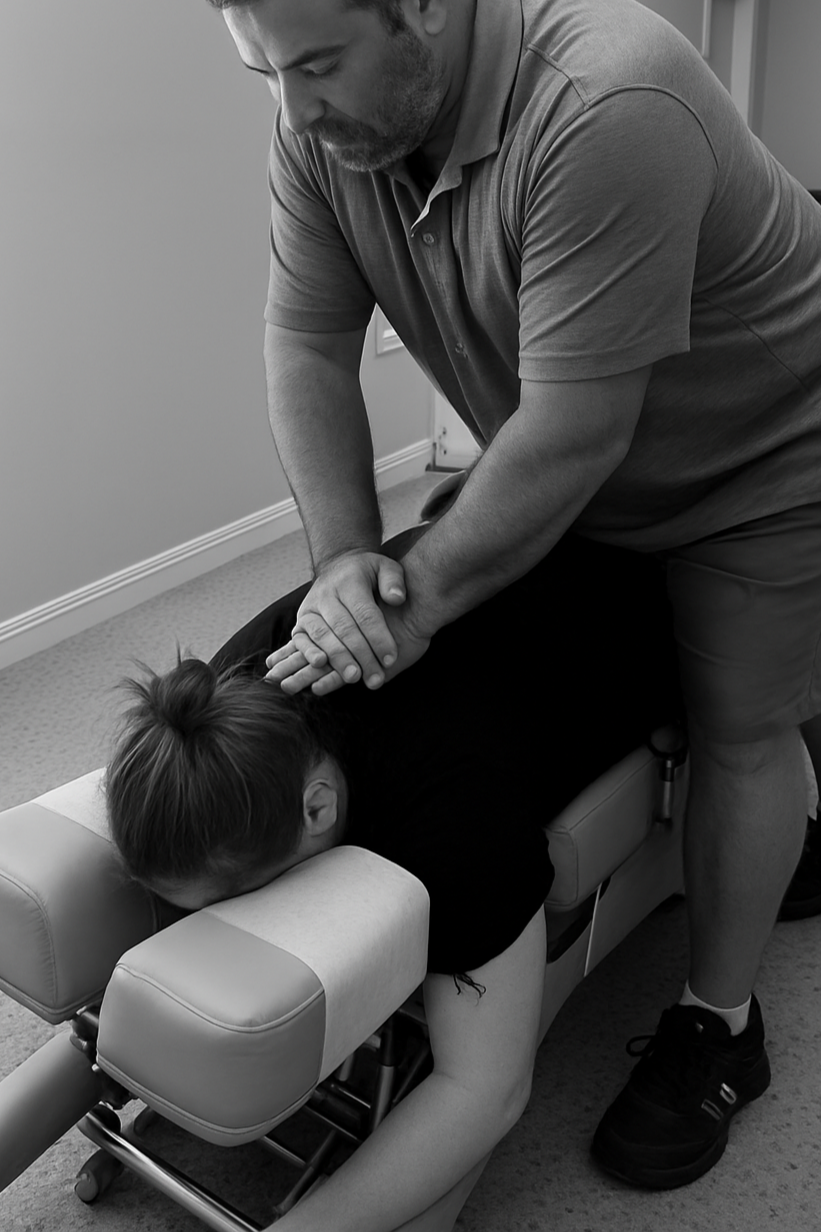
Hands-on spinal adjustments may help restore motion in restricted segments when they are appropriate for you. Adjustments are personalized to your condition, comfort level, and goals. We do not use a one-size-fits-all approach.

An adjustment is not meant to force your body into a rigid position. It is one part of a larger plan to improve movement and reduce unnecessary stress. Your care may also include posture education, stretching, rehabilitative exercises, chiropractic adjustments and mobility care, and guidance for your everyday activities.
Exercise is the other major piece. If posture is partly an endurance problem, then part of the solution is gradually building endurance. That may mean helping the deep neck flexors last longer, improving the upper back’s ability to support you without burning out, training the trunk to tolerate upright positions better, and improving the strength and control of the hips so the whole system shares the work.
We keep this practical. The goal is not to have you think about posture every second of the day. The goal is to build enough capacity that better positions start to happen with less effort and less self-correction.
Short position changes matter too. In many cases, doing a little bit often works better than heroic holding. Brief resets, small movement breaks, comfortable standing and sitting options, and exercises that give your body more choices can all help. Over time, the body is less likely to keep choosing the slouch when other positions no longer feel expensive.
If your evaluation suggests that another therapy may be useful, our clinic also offers decompression therapy, shockwave therapy, and dry needling. These services are not automatically used for every patient. We recommend care based on your symptoms, examination, and goals. You can learn more about our approach on our frequently asked questions page.

If Your Pain Is Tied to Desk Hours, Read This Next
Some posture problems overlap with long workdays, but they are not exactly the same conversation. If your pain is specifically tied to hours at a desk, read our guide Neck and Back Pain Relief in Knoxville: Why Your Desk Job Hurts. That article focuses more on desk-related strain, and the two pieces work well together.
REAL PATIENTS. REAL PROGRESS.
A personalized plan begins with being heard. One patient, Keela Buckley, described her experience this way:
“Dr. Poisal is a top notch Chiropractor. I feel like he truly understands the human body and how it should work. He asks questions and takes time to listen to the response before coming up with a plan of action. I trust his decisions and that his plan of care is what is best for me to get back to 100%. He deserves 10 stars!”
That focus on listening is especially important when you have already tried other treatments or have been dealing with pain for a long time. Your symptoms and goals deserve individual attention.
Work Toward Movement That Lasts
The purpose of care is not simply to remind you to “sit up straight.” It is to help you understand why your body keeps returning to the same pattern, improve how you move, and build the capacity to do more comfortably.
For some people, progress means less burning between the shoulder blades by the end of the day. For others, it means less neck tension, easier breathing, more comfortable workouts, or being able to sit, stand, and walk without constantly correcting themselves. Aging adults may want to stay independent and active. Younger adults may want to work, train, and enjoy their weekends without pain controlling their choices.
Results can vary because every person has a different history, body, and daily routine. We track your progress and adjust your plan as your needs change.
If you have sudden severe pain, new weakness, significant numbness, loss of coordination, changes in bladder or bowel control, or a sudden severe headache, seek prompt medical evaluation.

Take the Next Step in Knoxville
If you keep catching yourself slouched and cannot understand why it keeps happening, posture correction knoxville tn care may help you find the reason. You do not have to figure it out alone.
Dr. Arthur Poisal Chiropractic provides personalized care in Knoxville, TN, near Whittle Springs. We take time to understand what is happening and help you choose a manageable next step.
Call us at (865) 687-5700 or visit us at:
3371 Whittle Springs Road
Knoxville, TN 37917
You can also book a visit through our contact page. We’ll be happy to answer your questions, call you back, and help you get started.