Chiropractic Care for Mobility in Knoxville: Get Moving Without Pain

If you’re searching for chiropractic care for mobility knoxville, you may be looking for more than short-term pain relief. You may be at the point where a simple movement now takes planning. Maybe getting down to the floor with a grandchild has turned into a quiet calculation about how you’re going to get back up.
Mobility is the goal.
At Dr. Arthur Poisal Chiropractic, one thing we commonly see in our office is that people don’t usually come in saying, “I need better mobility.” They come in saying they avoid the floor now. They take the elevator instead of the stairs. They brace a hand on the wall to tie a shoe. They move more carefully than they used to because their body no longer feels reliable.
What Mobility Really Means
Mobility isn’t just about being flexible. It includes three important parts:
- Range of motion: How far a joint can move.
- Control: How well you can guide that movement.
- Confidence: Whether you trust your body to move without pain or hesitation.
That frame matters because losing the ability to get down to the floor and back up usually isn’t caused by one thing alone. A lot of patients assume it’s just age, or just stiffness, or just weak legs. In reality, that everyday movement asks for all three at once. You need enough motion through the ankles, knees, hips, and trunk to get into position. You need enough control to lower yourself without collapsing or twisting around a weak spot. And you need enough confidence to do it without feeling like you might get stuck there.
When one of those pieces starts to fade, the movement changes. You may hover and hesitate before you kneel. You may look for a chair or countertop before you try. You may avoid the floor altogether, not because you absolutely can’t do it, but because it has become uncertain.
Why This Particular Loss Matters
Getting down to the floor and back up is one of the clearest everyday markers of independent mobility.
It combines a lot of physical demands into one normal task:
- Hip and knee range of motion
- Ankle mobility
- Leg strength
- Balance
- Trunk control
- Confidence under load
That’s why this loss matters more than people realize. It’s not just about one awkward moment in the living room. It often becomes the point where your world starts shrinking in quiet ways.
If the floor feels difficult, you may stop stretching there. You may avoid playing with grandchildren at their level. You may change how you garden. You may skip chores that involve kneeling, reaching low, or getting under something. Even getting up from a low couch or stepping down the last stair can start to feel more deliberate.
And once you begin avoiding those positions, the body usually gives you less and less access to them. Joints that aren’t taken through range tend to feel stiffer. Muscles that aren’t challenged tend to get weaker. Balance gets less automatic. Confidence drops further. The movement that felt hard starts to feel impossible, not because your body changed overnight, but because the pattern slowly stopped being practiced.
That’s the bigger picture we want people to understand. The problem is not always located in the place you notice it most. If getting off the floor feels hard, your knees might complain, but the real issue may involve hip motion, ankle stiffness, trunk strength, fear of loading one leg, or a combination of all of the above.
What a Mobility Assessment Actually Finds
Good care begins with listening, but it also needs a clear look at what your body is and isn’t doing.
If your main complaint is that getting off the floor has become a struggle, we don’t want to guess. We want to find out what part of the movement is breaking down.
One part of that assessment is ankle and hip motion. Floor transfers and stairs demand more from those joints than most people think. If your ankle doesn’t bend enough, your body may tip forward or rotate around it. If your hip doesn’t move well, your lower back or knee may absorb more stress than it should. We check those areas because the movement has to be available before it can become comfortable.
We also look at single-leg balance and control. Can you stand on one leg without immediately wobbling or grabbing support? Can you shift your weight confidently from side to side? Those questions matter because getting up from the floor is rarely a perfectly symmetrical movement. At some point, one leg has to accept more load while the other helps stabilize. If that control is missing, the whole task starts to feel shaky.
Trunk and hip strength matter too. Can you lower yourself with some control, or do you drop the last part of the way? Can you push yourself back up through your legs, or do you need both hands and a nearby surface every time? We’re not judging the effort. We’re identifying what your body currently has available and what it’s substituting around.
We also watch how you load and move in more ordinary patterns. Walking, sitting down, squatting, stepping up, stepping down, and turning all tell a story. Sometimes the compensation shows up before pain does. You may lean away from one side. You may rush through one phase of the movement. You may avoid bending a knee or loading a hip. Those patterns help us understand whether the floor is the true problem or simply where the larger mobility issue becomes most obvious.
What a Realistic Rebuild Looks Like, Week to Week
Most people do better when they know what progress actually looks like.
Early on, the goal is often to restore range and reintroduce the movement in a scaled-down way. That might mean working from a higher surface instead of the floor, using a sturdy support, or practicing only part of the sequence. If getting all the way down and back up feels too far away right now, we don’t need to force it on day one. We can break it into pieces your body can learn from.
As range starts to improve, the work usually shifts toward strength and control. That means helping your legs and trunk handle the movement with less strain. Instead of just surviving the task, the goal is to make it cost less effort. One thing we commonly see in our office is that a movement becomes more possible before it becomes more comfortable. That’s normal. The body often needs repetition before it starts to trust the new pattern.
Then comes the part many people overlook: confidence. If a movement has felt risky, frustrating, or embarrassing, your nervous system remembers that. So part of rebuilding mobility is practicing the exact thing you’ve been avoiding in a controlled setting until it feels less threatening. Not reckless repetition. Not “push through it.” Just steady exposure with the right support and progression.
That may mean practicing a floor transfer with assistance, then with less assistance, then from a lower starting point, then with a smoother return to standing. It may mean working on stairs in a way that helps you rely less on the railing over time. It may mean relearning how to bend toward a shoe without instantly bracing for the pull or pinch you expect.
And progress is best measured in real-life terms. Can you get off the floor with less struggle? Can you use one hand instead of two? Can you take the stairs without planning each step? Can you move through your house with less hesitation? Those are the changes that matter.
How Hands-On Care May Fit In
If part of the problem is that a joint simply isn’t moving well, hands-on care may help create a better starting point.
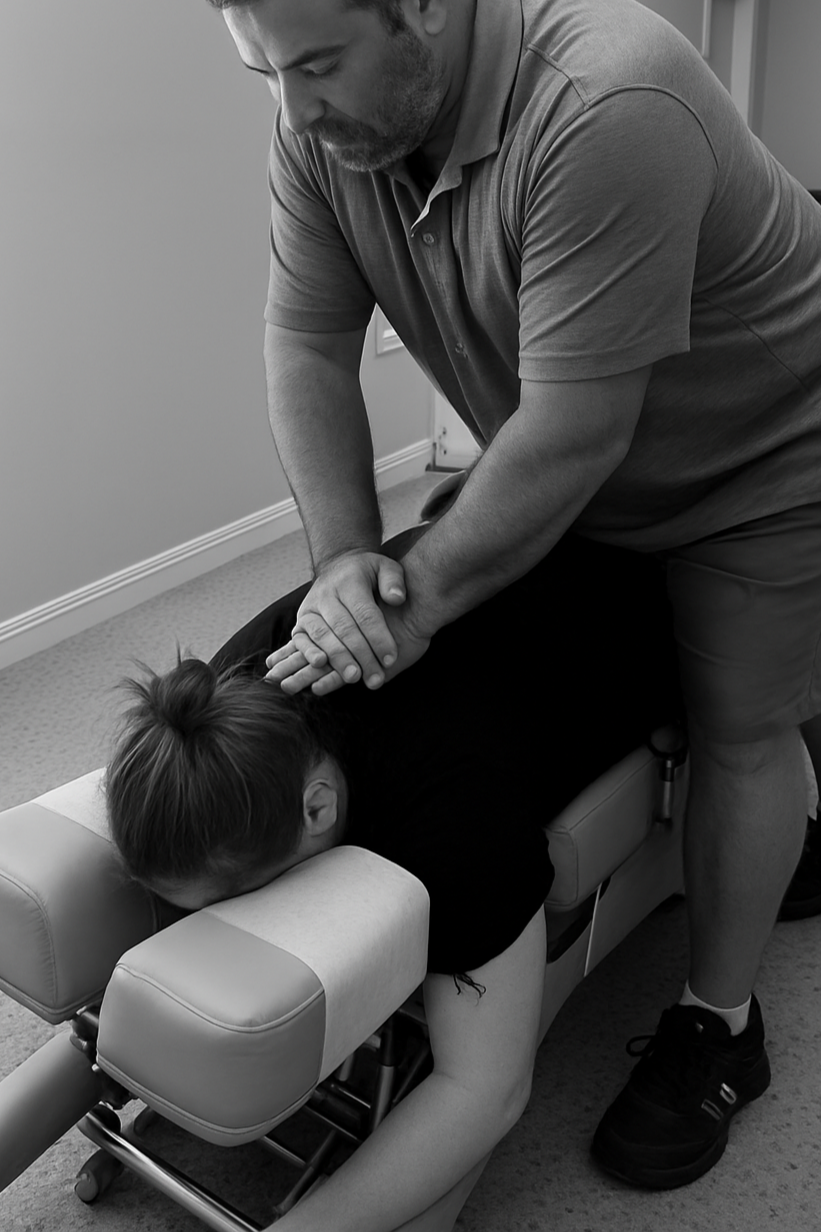
When the spine, hip, or another joint is restricted, a targeted adjustment may help restore motion so the movement work is more available and less guarded. That’s one reason we often pair hands-on treatment with active rehab instead of treating them like separate ideas. Better motion is useful, but what you do with that motion is what helps it carry over into daily life. You can learn more about that approach through our chiropractic adjustments and mobility care.
In some cases, persistent soft-tissue irritation is also part of the picture. If muscles or tendons remain stubbornly sensitive or restricted, Shockwave Therapy may be considered after assessment. It’s non-invasive, and for the right problem it may help stimulate a healing response in irritated tissue, but it can be uncomfortable during treatment and it isn’t appropriate for every diagnosis. We don’t use it as a catch-all, and it’s not the right fit for tears, nerve-related symptoms, or instability. No single treatment replaces a thoughtful plan.
Mobility-Focused Care in Knoxville, TN
If you live in Knoxville TN, including the Whittle Springs area, and you’ve started avoiding the floor, the stairs, or that simple bend to tie your shoe, it’s worth paying attention to. Those changes can seem small from the outside, but they often reflect a meaningful shift in range of motion, control, and confidence.
At Dr. Arthur Poisal Chiropractic, we care for patients of all ages, and we try to keep the focus practical. If a movement matters to your daily life, it matters to the plan. We’ll listen to your concerns, assess how you move, and explain your options clearly so you understand what may be contributing and what rebuilding might realistically involve.
You can learn more about our approach on our About Us page or review common questions on our FAQ page.
Let’s Get You Moving Again
If you’ve been looking for chiropractic care for mobility knoxville, you don’t need to wait until the problem becomes bigger. Tell us what movement has started to feel uncertain, what you’ve stopped doing, and what you’d like to get back to.
Call us at (865) 687-5700, or fill out our contact form and we’ll be happy to call you back. We’ll help you take the next step at a pace that feels comfortable and manageable.