Frozen Shoulder Treatment Knoxville TN: Get Moving Again

You notice it when simple tasks stop being simple. Reaching for your seatbelt hurts. Pulling on a shirt becomes a careful, two-handed process. Drying your hair or reaching into the top cupboard feels nearly impossible. You may wonder why your shoulder has become so painful and stiff when you can’t remember one specific injury.
If you’re looking into frozen shoulder treatment Knoxville TN, the first step is understanding what may be limiting your movement. Frozen shoulder can improve, but it often requires patience, a careful assessment, and a plan that matches the stage of the condition.
Frozen Shoulder Treatment Knoxville TN: Why Does the Shoulder Get So Stiff?
Your shoulder is a ball-and-socket joint. The upper arm bone sits in a shallow socket, allowing your arm to move in many directions. The joint is surrounded by a flexible layer of tissue called the shoulder capsule.
With frozen shoulder, also called adhesive capsulitis, that capsule becomes irritated, thickened, and tight. It gradually loses its ability to stretch as your arm moves. The muscles and nerves around the shoulder may also become more protective, especially when movement repeatedly causes pain.
This can create a frustrating cycle:
- Movement hurts.
- You begin using the arm less.
- The shoulder becomes more guarded and under-used.
- Stiffness increases.
- Everyday movements become even more difficult.
One thing we commonly see in our office is that people try to protect the shoulder by barely moving it. That response makes sense when movement hurts, but prolonged avoidance can give the shoulder fewer opportunities to maintain its range.
The three phases of frozen shoulder
Frozen shoulder usually develops in three broad phases. The timing varies from person to person.
1. Painful or freezing phase
Pain gradually increases, often without one clear injury. Movement becomes more limited as the shoulder grows more sensitive. This phase may last for several months.
2. Stiff or frozen phase
Pain may settle somewhat, but stiffness becomes the main problem. You may be unable to raise your arm, reach behind your back, or rotate your arm outward. The shoulder can feel as though it has reached a firm stopping point.
3. Thawing or recovery phase
Movement gradually returns. Progress may be slow, but everyday tasks often become easier as the capsule and surrounding tissues regain tolerance.
The full process commonly takes months and sometimes longer. That does not mean you should ignore worsening symptoms. It means realistic care should focus on steady progress rather than promising a quick fix.
What Can Trigger a Frozen Shoulder?
Frozen shoulder is not always caused by one accident or one damaged structure. Several factors may contribute, including:
- Diabetes
- Thyroid conditions
- A period of immobility after surgery or injury
- Shoulder pain that leads you to stop using the arm
- Being between 40 and 60 years old
- Long-standing posture and movement habits
- Changes in activity, strength, or upper-back mobility
A lot of patients assume the painful area must be the only problem. The bigger picture can be more complicated.
The shoulder blade, upper back, neck, ribs, and shoulder joint all contribute to arm movement. If the upper back is stiff, the shoulder blade may not move as freely. If the neck or upper back is sensitive, you may hold the shoulder differently. If the rotator cuff and other supporting muscles are not being used normally, the joint may become less confident with reaching and lifting.
The driving factor may not be located exactly where the pain is felt. That is why a thorough evaluation looks at the shoulder and the surrounding movement system.

How Can You Tell Frozen Shoulder From Other Shoulder Problems?
Several shoulder conditions can cause pain, but the movement pattern often provides useful clues.
With a rotator cuff problem or bursitis, you may have pain during specific movements, such as lifting your arm overhead or reaching out to the side. Strength may also be reduced. Some positions may hurt while others remain comfortable.
With arthritis, stiffness and pain may occur with joint loading, and imaging may show changes within the joint.
Frozen shoulder tends to create a more consistent loss of movement. Both active range of motion, which you perform yourself, and passive range of motion, when someone carefully moves your arm for you, may be restricted.
A classic pattern is:
- External rotation becomes limited first
- Reaching overhead becomes difficult
- Reaching behind your back becomes difficult
- Movement is restricted in several directions
- Onset is gradual rather than sudden
- Pain may be worse at night, especially during the painful phase
These patterns are not a diagnosis by themselves. A careful exam helps determine whether the capsule, rotator cuff, neck, nerves, upper back, or another structure may be involved.
For more on how shoulder problems can affect your evenings, read our guide to why shoulder pain can be worse when you sleep. That article focuses more on nighttime discomfort, rotator cuff irritation, bursa sensitivity, and sleep positioning.
When Should You Have the Shoulder Evaluated?
Consider an evaluation if stiffness is steadily increasing, your arm movement is changing, or the problem is interfering with dressing, grooming, work, exercise, or household activities.
During an assessment, we may:
- Ask when the pain and stiffness began
- Review injuries, surgery, medical conditions, and activity changes
- Test active and passive shoulder range of motion
- Compare external rotation, internal rotation, and elevation
- Assess strength and muscle control
- Use appropriate impingement and orthopedic tests
- Examine the neck, shoulder blade, ribs, and thoracic spine
- Look at posture and movement patterns
- Screen for red flags that require another level of care
We take time to listen before creating a plan. Your description matters. The difference between gradual stiffness and sudden weakness, for example, can change what makes sense next.
Seek prompt medical evaluation after significant trauma or if you have sudden weakness, a visible deformity, fever, marked swelling, new numbness, chest symptoms, or rapidly worsening pain.
What Can You Do at Home?
The goal is usually not complete rest. It is controlled movement within a tolerable range.
You may find it helpful to:
- Keep using the arm for comfortable daily activities.
- Perform gentle mobility movements without forcing the shoulder.
- Use heat before movement if it helps the area feel less guarded.
- Support the arm with a pillow when resting.
- Temporarily reduce heavy overhead lifting and repetitive reaching.
- Change positions regularly rather than holding the shoulder still for long periods.
- Pay attention to how the shoulder responds later that day and the next morning.
If rounded posture and stiff upper-back mechanics are making shoulder movement harder, this article on posture and upper-back mechanics that support shoulder movement may also be helpful.
Avoid the “no pain, no gain” approach. Forcing a stiff shoulder aggressively can increase irritation and make it harder to move comfortably afterward. A useful stretch may create mild tension, but sharp or escalating pain is a reason to ease off.
It also helps to be patient. Frozen shoulder often changes slowly. A good plan may involve small improvements in motion, dressing, reaching, and daily confidence rather than dramatic changes overnight.

How May Chiropractic Care Help?
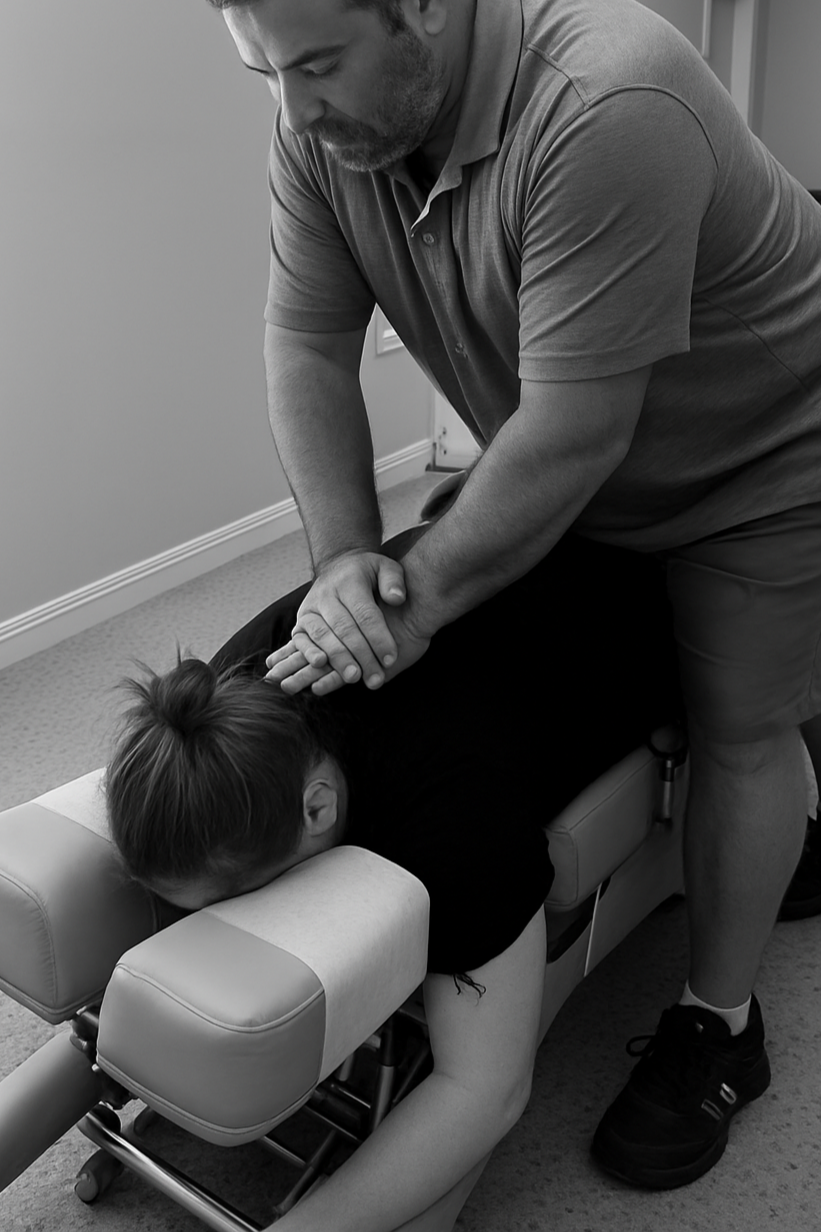
Care depends on your assessment and the phase of the condition. Hands-on chiropractic care may include gentle work to the shoulder, neck, upper back, ribs, or thoracic spine when restricted movement in those areas is contributing to how you use the shoulder.
Adjustments are not intended to force a tight capsule open. They may be one part of a larger plan to improve movement options around the shoulder and help reduce protective tension.
Rehabilitative exercises may focus on:
- Comfortable shoulder range of motion
- External rotation
- Shoulder-blade control
- Upper-back mobility
- Rotator cuff strength
- Gradual tolerance for reaching and lifting
You can learn more about our approach to shoulder pain treatment in Knoxville, including how we assess the neck, upper back, and shoulder together.
In selected cases, shockwave therapy for stubborn soft-tissue problems may be considered alongside a mobility plan. Shockwave therapy uses focused sound-wave pulses over a selected area. It may be useful when soft-tissue sensitivity or capsular restriction remains stubborn, but it is not appropriate for every diagnosis and does not guarantee full recovery.
Other services, such as spinal decompression or dry needling, are not automatic treatments for frozen shoulder. They may only be considered if your examination identifies a separate problem where they are relevant. The plan should be based on what we find, not on using every available technique.
For a plain-language explanation of what an adjustment involves, you can also read what to expect from a chiropractic adjustment in Knoxville.
Getting Back to the Activities You Miss
For an active adult in Knoxville, stiffness can interfere with hiking, paddling, lifting, gardening, or tennis. For a senior near Whittle Springs, the goal may be simpler: reaching the top shelf, putting on a jacket, or moving through the morning without guarding the arm.
Those goals are important. Care should connect to what you want to do, not just to a number measured during an exam.
Dr. Arthur Poisal Chiropractic is located at 3371 Whittle Springs Road, Knoxville, TN 37917. If shoulder stiffness is changing your daily life, call (865) 687-5700 or send us a note through our contact page. We’ll listen to what’s happening, explain what we find, and help you decide on a comfortable next step.
Frequently Asked Questions
Does frozen shoulder go away on its own?
It may improve over time, but the process can take months or longer. An evaluation can help confirm that the stiffness fits frozen shoulder and identify ways to maintain useful movement while the condition progresses.
Is it safe to stretch a frozen shoulder?
Gentle, tolerable mobility work is often helpful. Aggressive stretching that causes sharp pain or a lasting flare-up may be counterproductive. The right intensity depends on your symptoms and the phase of the condition.
Why is external rotation limited first?
The shoulder capsule often tightens in a pattern that makes outward rotation difficult early on. You may notice problems reaching behind your head, putting on a coat, or positioning your arm away from your body.
Can frozen shoulder be caused by diabetes or thyroid disease?
Diabetes and thyroid conditions are associated with a higher likelihood of adhesive capsulitis. If you have one of these conditions and notice progressive shoulder stiffness, an early evaluation is reasonable.
When should I seek urgent care?
Seek prompt medical attention after major trauma, sudden inability to use the arm, visible deformity, fever, significant swelling, new neurological symptoms, chest pain, or rapidly worsening weakness.